
Durham’s future depends on its environment. Every time the city expands, the fight over water and land begins again. For decades, the People’s Alliance has stepped in: from citywide recycling campaigns to fighting landfill expansions and pushing for cleaner water, PA has been there to demand real accountability and lasting protections.
Where it all begins...
Falls Lake, Eno River, Lake Mitchie, Little River.
To most Durhamites, these words are more than names on a map. They supply drinking water, shape neighborhoods, and have sparked decades of debate over what kind of city Durham should become. As the city grew, new highways, developments, and recurring droughts put more pressure on these critical areas, turning local streams into battlegrounds over the city’s future.
Before People’s Alliance, groups like the Eno River Association were already fighting to protect these natural resources. Milo Pyne, later a key voice within PA, was part of those early efforts, learning firsthand how real change in Durham happens when everyday people challenge decisions made behind closed doors. He saw that effective advocacy means more than just showing; it means coming prepared with facts, alternatives, and a willingness to outlast the opposition. These early battles laid the groundwork for an activism model that combined community organizing, strategic alliances, and persistent advocacy.
When PA stepped in, they amplified that model and took it further. Members rigorously reviewed city ordinances, contracts, and scientific studies, calling out errors in watershed maps and identifying loopholes in proposed development plans. From fighting the Treyburn development to pushing back against landfill expansions, PA offered data-driven critiques and pushed for accountability in public hearings and council meetings. Through community organizing, letters to politicians and editors, and direct conversations with local leaders, PA consistently advocated for stronger environmental protections grounded in thorough research and the amplification of community voices.
Activism highlights
After its founding, PA quickly began to tackle Durham’s most contentious environmental issues. From riverbank debates to city hall showdowns, PA made sure public interest came before private gain. Each of these major campaign reflected how PA leveraged research, public outreach, and relentless advocacy to steer the city towards cleaner water, better waste management, and stronger protections for public health and green spaces.
1995-97: Solid waste & Landfill: The Battle for Public Trash
Few campaigns did more to define PA’s impact than the fight to keep Durham’s trash collection public. When city officials pushed to hand waste collection over a private waste management company, PA made it a citywide issue. They organized a standing-room-only forum, distributed flyers and position papers, and turned-out residents to city council meetings to demand transparency and accountability.
As early as 1991, PA warned city officials that “privatization threatens job security for city workers and puts profit before the public good” (Box 32: PA letter to Mayor Jenkins). Throughout the mid-1990s, PA kept up steady pressure, arguing that city-run services meant better recycling programs, stronger union protections, and more control over costs and environmental standards. The campaign hit its peak in 1997, when public pressure forced city leaders to abandon the privatization plan and keep waste collection in public hands.
As of 2025, Durham’s trash collection is still city-run, not privatized. The city continues to provide municipal curbside pickup, recycling services, and yard waste collection. Through recycling rules and pickup schedules have evolved, the basic system that PA fought for is still standing.
1991-92: Durham recycles / Sun Shares
In the early 1990s, PA and its partners took the lead on pushing Durham to adopt curbside recycling. They partnered with Sun Shares, a volunteer-driven nonprofit, to advocate for aggressive city action. They met with city officials, distributed educational flyers, and backed the Sun Shares contract that made recycling accessible to thousands of households. Their efforts paid off: In 1991, the city approved a contract with Sun Shares, and by January 1992, Durham launched a citywide curbside collection program which quickly reached more than 18,000 homes. This was a classic PA campaign: organized, persistent, and focused on real results. Their efforts helped make recycling part of everyday life for people across Durham. By building support from the ground up, PA and Sun Shares showed how local activism could drive lasting change in city policy.
1991-93: Stormwater Fee
In the early 1990s, as stormwater pollution became a growing concern, PA zeroed in on how Durham funded and managed its runoff. Members dug into city budgets, attended public meetings, and pressed for a dedicated stormwater fee that would require both residents and businesses to help cover the costs of runoff control and infrastructure upgrades. PA argued for a fair system that didn’t let large commercial users off the hook. They also demanded that new fees go directly toward physical repairs, not just administrative expenses.
After a series of heated debates, the city adopted a two-tiered fee structure in 1991. PA kept up the pressure as churches and some businesses challenged the plan in court and pushed city leaders not to cave to special interests. They continued to fight until 1997 and beyond. Even as the fee was later reduced and restricted by a court ruling, the system PA fought for still remains in place today, funding stormwater infrastructure and pollution control. PA’s advocacy forced the city to treat runoff as a shared responsibility and put the issue on the public agenda for good.
1996-97: Resource Protection Ordinance
In 1996-97, PA was at the center of Durham’s fight to protect its last remaining floodplains, wetlands, and natural buffers from overdevelopment. As the city debated the new Resource Protection Ordinance (RPO), PA members mobilized allies, sent advocacy letters, and turned-out supporters to hearings. Their main demand: don’t let business interests “gut the ordinance with endless hearings and rewritten drafts.” PA made the stakes clear and warned that watering down the rules would mean that it was repeating the mistakes of other cities that allowed sprawl and flooding.
Developers and business groups tried to weaken the final version by blaming environmental protections for housing costs. PA called them out, pointing out that it was “highly suspect” since less than 1% of land would be affected, and most new housing could still be built elsewhere.
The final RPO wasn’t perfect, but it did set a new standard for defending Durham’s natural landscape and showed what organized local advocacy could accomplish when big development was on the line.
2006-08: Lead Contaminations/Abatement
Since the early 2000s, PA has played a key role in Durham’s fight to reduce childhood lead poisoning. Working alongside the Children’s Environmental Health Initiative (CEHI). Community leaders like Lorisa Seibel, and other local partners, PA helped support new tools that let health officials identify and fix lead hazards in homes before children get sick. This proactive approach has led to a 600% increase in early identification of homes with children with elevated blood-lead levels.
While most of the technical heavy lifting came from CEHI, PA focused on public outreach, education, and making sure families, especially from at-risk neighborhoods, knew about testing and prevention resources. PA’s work in the Durham Environmental Lead Collaborative helped raise awareness, encouraged early intervention, and pushed the city to take real steps.
In 2008 CEHI and its partners, including PA, were recognized with the EPA’s National Achievement in Environmental Justice Award.
Treyburn: A Case Study in Defending Durham’s Water
All of the campaigns above showed how PA could turn community activism into real policy change. But there was an earlier fight that set the tone for everything that followed: the battle over the Treyburn watershed. This case became the blueprint for PA’s environmental activism approach, where they combined technical research, coalition-building, and public pressure to defend Durham’s water at its source.
In the mid-1980s, as Durham looked to expand north, it ran straight into a problem: the land set aside for new growth overlapped with the sources of the city’s drinking water. Treyburn, a massive development project, promised new homes, businesses, and jobs, but it also raised serious concerns about water quality and the long-term health of Durham’s reservoirs.
Treyburn quickly became more than a question of economic development. Every decision about sewer lines, land use, and regulation had immediate implications for the city’s water supply. The resulting debate put watershed protection at the center of civic life and forced leaders and residents to confront the trade-offs involved. PA was at the forefront of this sight, turning technical concerns into urgent public issues.
Watersheds – why they matter, how they work
Durham’s water supply starts with its geography. The city sits on a ridge: water falling on one side flows northeast towards Falls Lake and the Neuse River, while rainfall on the other side heads southwest to Jordan Lake and then the Cape Fear River. Water flow determines who relies on it and who suffers from pollution.
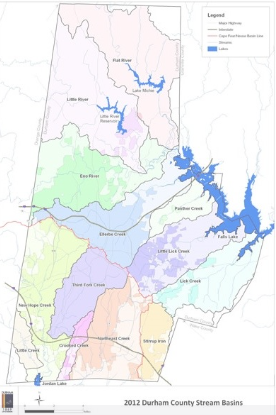
Most of Durham’s water comes from Lake Michie (built 1926) and the Little River Reservoir (opened 1987), both up north. From there, water flows into Falls Lake (created in 1981), which also serves as a flood control project for the region.
A “watershed” is defined as the land area that drains into a common water body – Lake Mitchie, Little River Reservoir, or Falls Lake. However, as argued by Alice Cohen, “watersheds” can also act as “boundary objects,” shaped and reshaped by science, politics, and activism. Their boundaries are part physical and part political, determining which areas are regulated, who pays, and who benefits. This makes watershed protection a deeply contested process – not only about water quality, but also city growth, development rights, and how environmental risks are distributed.
Protecting watersheds means controlling runoff, liming new roads and sewer lines, and restricting dense development near reservoirs. In the 1980s and 90s, city and county officials fought over how much protection was enough, especially for the land draining into drinking water reservoirs. Treyburn became the flashpoint, since any development there would affect downstream water quality.
The technical fight was over zoning lines, impervious surface limits, buffer rules, and stormwater controls. The political fight was over who got to draw those boundaries and whose priorities shaped policy. And the cultural flight – echoing Cohen – was about what the watershed meant for Durham: a symbol of public trust, community identity, and the struggle of the city’s most vital resource. All of this came to a head in the battle over Treyburn.
The Treyburn development, 1985-96
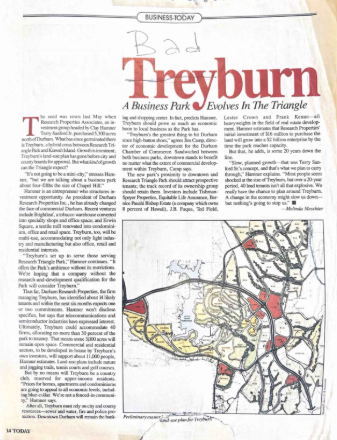
In the mid-1980s, Durham’s leaders faced a choice: approve Treyburn, a sprawling, high-end development promising jobs, homes, and tax revenue, or protect the city’s drinking water. Treyburn’s 5,000 acres sat directly on top of the Little River and Lake Michie watersheds, the main sources of Durham’s water. To some, Treyburn signaled progress. To others, it was a direct threat.
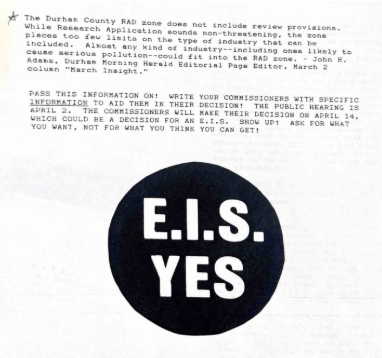
PA saw the risks early and moved quickly with a data-driven response. In 1986, they called for a full, independent Environmental Impact Statement (EIS) before any rezoning, citing experts like Daniel Okun (UNC public health) and biologist Gerald B. Pottern, whose research spelled out the risks of runoff and pollution.
PA drilled into city reports, zoning maps, and ordinances. Internal memos flagged missing or inaccurate watershed boundaries and questioned whether hydrology studies had been done correctly. In a March 8, 1986 newsletter, PA urged members to “arm yourself with facts” and push for an EIS, warning that “developer-offered mitigation barely halves pollutions at best.” Using Pottern’s science, they argued that even small spills of chemicals or fuel could have outsized impacts once new sewer lines and subdivisions arrived.
Their letters to city officials were clear: the city needed “err on the side of protection,” since “once land is developed, it’s lost forever as a natural water filter.” This pressure forced city officials to slow down and, after years of public scrutiny, led to comprehensive watershed study of Falls Lake and Little River (completed 1995). This data-driven approach set the stage for all the organizing and coalition-building that followed.
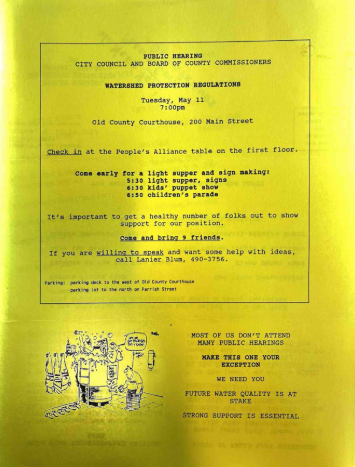
They also brought the technical fight to the broader community. They organized mass turnouts at public hearings, packed council chambers, ran phone banks, and blanketed the city with newsletters and flyers. Their March 8, 1986, newsletter laid out the facts, action steps, and direct contact info for officials. They urged readers to call the County Planning Department and made it easy to write or call commissioners directly. The “EIS YES” campaign was visible at every meeting, with signs and organized public comments making sure officials couldn’t ignore the pressure. PA’s message was clear: “Don’t wait for someone else – do it yourself.”
Transparency was another core PA strategy. In May 1987, PA sent a letter to Mayor Gulley and council leaders (signed by Jennifer McGovern and others), explicitly rejecting any negotiation over the Urban Growth Boundary behind closed doors: “We reject previewing any ‘concessions’ proposed by Treyburn developers; the UGB extension is unnecessary, premature, and potentially illegal.” PA’s stance was that every decision had to happen at open council meetings, on the record, with no piecemeal deals or secret amendments. PA kept the pressure public. Council notes from June 1987 show every option was contested and no decisions made quietly. They ensured their demands and concerns were published in the press, keeping city officials accountable and the debate open. PA insisted their demands be published in the press and made sure city officials were held accountable in public. Every decision had to withstand public and scientific scrutiny.
PA didn’t do all this alone. They partnered with Save the Water and the Eno River Association to unify demands and amplify their advocacy. Their collaboration was hands-on: PA’s then-president Jennifer McGovern regularly shared draft ordinances, legal language, and strategy with partner groups. In a handwritten letter dated May 8, 1987, Jim Clark (Save the Water) sent McGovern a model ordinance and thanked her for her help: “Mother Nature secretary gave me hope you like it [sic]." This was an example of how grassroots strategy worked on the ground.
Together, these groups coordinated joint letters. The April 27, 1993, letter to the County Board of Commissioners cited legal precedent and state environmental policy, demanding that no new regulations weaken existing watershed protections. The threat of litigation was always in the background: “If we need to, we’ll sue NC DOT [Department of Transportation].”
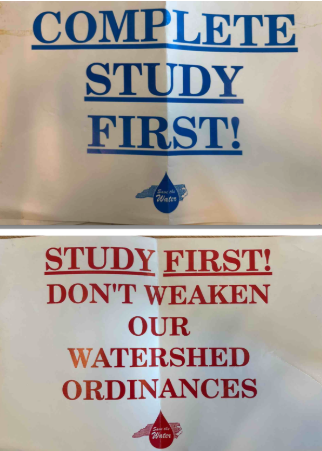
Coalition letters and editorials emphasized strict zoning, WS-I protection, and a hard line against new sewer lines in the watershed. As a result, Treyburn’s approval was slowed, a full comprehensive watershed study was ordered, and developer concessions and new zoning restrictions were imposed. These are outcomes that would not have happened without this organized resistance.
The Fight Continues
Today, if you look at Durham’s “State of Our Streams” report, you’ll find the legacy of these fights. The city still grades watersheds, tracks water quality, and holds public meetings about new threats and fixes -- habits born in the contentious debates of the 80s and 90s. Cohen had it right: in the end, water is as much about politics and people as it is about geography.
Of course, PA’s activism didn’t start or end with Treyburn. Over the years, they’ve taken on everything from lead abatement to nuclear education to fighting landfill privatization. Not every campaign was a “win” or changed policy, but PA did ask the questions publicly: Who benefits? Who pays for pollution? Who decides what counts as “the public good”?
If Durhamites today can take clean water and protected land for granted, it’s because groups like PA didn’t let these decisions slide by without a fight. Every time a new project is scrutinized, every time watershed maps are redrawn, and every time a resident stands up at a public hearing, that legacy is visible.
Milo Pyne put it best: sometimes, you have to show up with the facts, call out officials directly, and refuse to let things go unchallenged. That kind of persistence and skepticism, always demanding answers and pushing for real alternatives, is at the core of PA’s legacy and values.
Showing 5 reactions
Sign in with
Then, at the influential behest of the owners of Treyburn, state legislators immediately acted to undermine not only Durham but all NC and local zoning and watershed protection. PA’s organizing and advocacy was and still is a game changer. Incremental zoning and development decisions made today still preserve – or risk – the quality of Triangle drinking water. Property land owners and developers continue to challenge urban growth boundaries Indeed, we can never take clean water for granted.
Hurray hurray for PA’s persistent work, generation after generation. Thank you all!