
In July 1992, the Durham County and City School Systems merged after a fraught and protracted debate. For decades, the disparate systems had perpetuated profound inequities that harmed students of both systems but especially those within the predominantly black city system. The People’s Alliance played a significant role in supporting the merger, researching and publicizing the issue, organizing public forums, lobbying and petitioning governing bodies, and endorsing officials for the newly merged board.
The Durham City and County School Districts existed separately for nearly a century. Federally mandated desegregation, despite initial successes within Durham, had been curtailed by a series of court rulings that made it especially difficult to integrate the two systems. The city school system suffered from these failed attempts at desegregation, white flight to the county and suburbia, and subsequent urban decay. The disparate systems endured for decades until systemic inequities, which manifested in low achievement, the deterioration of infrastructure and instructional materials, and high dropout rates, renewed the push for consolidation. The issue of a merger was fraught, attributable to the dearth of popular support stemming from issues of taxation, race, and political representation whose roots went back decades. Its eventual success was the culmination of years of research, lobbying, and activism. Many citizens groups and community organizations contributed, with the People’s Alliance playing an especially integral role.
Durham City and County School Systems
Compared to other large North Carolina school districts, the consolidated Durham Public School system emerged very recently. Historically, the state and municipalities had chartered specialized school districts so that those within population centers could vest their substantially larger tax bases and bond monies within urban school districts. The Durham City System was established in 1887, distinct from the County District. The separate systems (both of which were segregated) endured for several decades with few overt complications. The Supreme Court ruling Brown v. Board of Education in 1954 mandated the desegregation of the schools of Durham. This event also became the occasion for talk of consolidating the two systems. Notwithstanding desegregation, proponents also saw consolidation as a means of correcting administrative inefficiency and reducing the overhead needed for the two separate systems. At this time, the population of Durham was rapidly growing, and there was new concern for inadequate policy mechanisms. The Board of County Commissioners administered the monies for the two systems in a bloated, arduous process, which even they found so onerous that they advocated for a consolidated system.
However, referendums for a merger would fail in both 1958 and 1968. The failure of the referendums was attributable to dissatisfaction with projected tax increases and opposition to merger-facilitated integration. Simultaneously, white families departed for suburbia to avoid attempts at desegregation and to flee the deteriorating city and its system, severely hemorrhaging the tax base of the city. The tax issue and other attendant disparities were most profound within enclaves designated “City-Out” areas. Within these enclaves, residents, despite living in areas annexed by the city, could decide whether they wanted their children in the city or county system. In 1932, the city had created a supplemental tax for schools. The fiscal discrepancy began the precedent of allowing residents of the annexed area to decide which district they belonged to. Up through 1955, the city government incorporated these annexed areas into the city district. Beginning 1955, however, parents in the affected areas opting into the city system became increasingly rare, and by 1971, these exceptional zones would result in only 46% of the Durham city area being operated by the city school district. Further, although residents were self-determined members of the county school system, those within “City-Out” enclaves benefited from city services and could even vote in city school board elections while escaping the taxes levied by the city system.
In the early 1970s, desegregation had made virtually no progress, and the schools of Durham were beginning to resegregate, increasing the concentration of black students in the city system. In the summer of 1971, notable charettes were hosted by the Save Our Schools (SOS) group. At the conclusion of the charrette, polled public opinion suggested public support for merger. That same year, the Board of the County Commissioner again pushed for consolidation with a coalition of Durham agents, citing verifiable economic rationale for merger. But this referendum failed as well. Perhaps surprisingly, opposition came from those within both the city and county systems. The black community feared electoral and administrative complications of the merger, since consolidation would likely oust black administrators and install a white majority in school board seats. The white population feared an increase in taxes, onerous busing and the deterioration of schools.
In a 1972 failed lawsuit, Wheeler v. Durham City Board of Education, the pro-consolidation plaintiffs argued that the white population used the suburbs and "city-out" enclaves as another means of segregation. The court ruled that the plaintiffs failed to demonstrate deliberate segregative action on the part of the white community, a ruling that would paralyze momentum for merger. Another ruling, the 1974 Supreme Court case Milliken v. Bradley, outlawed cross district busing to remedy segregation unless it was proven that a district was intentionally segregated. Together, these lawsuits severely curtailed the desegregation of Durham schools. Meanwhile, the inequities and systemic shortfalls of the two systems continued to harm students of both systems.
The Merger
In the 1980s, the County Commission reconsidered the merger, concurrent with the state legislature's encouragement for consolidation across the state. The manifestations of the inequities were no longer ignorable. The city school system had chronic delinquency and truancy, high dropout rates, and low academic achievement. Comparatively, the County system had high achievement and better student outcomes attributable to their larger tax base. The People’s Alliance became attuned to the relevance of the merger and began to heed the testimonies of their constituency concerning merger. On March 29, 1988, the People’s Alliance Education Committee hosted a public forum titled “To Merge or Not...,” to consider the issue of a merger internally. In the latter half of 1988, task forces to consider the feasibility of a merger were formed by the City School system and the County Board of Commissioners respectively, and these invited political and community representatives to participate. People’s Alliance elected Dabney Hopkins, who would later serve as the organization’s president, to serve on the City’s System-Wide Advisory Board (SWAB), which considered the merger on the behalf of the city system. For the Commissioner’s Merger Issues Task Force, the People’s Alliance elected Dr. Michael Freemark, the chairman of its Education Committee, to serve as their representative.
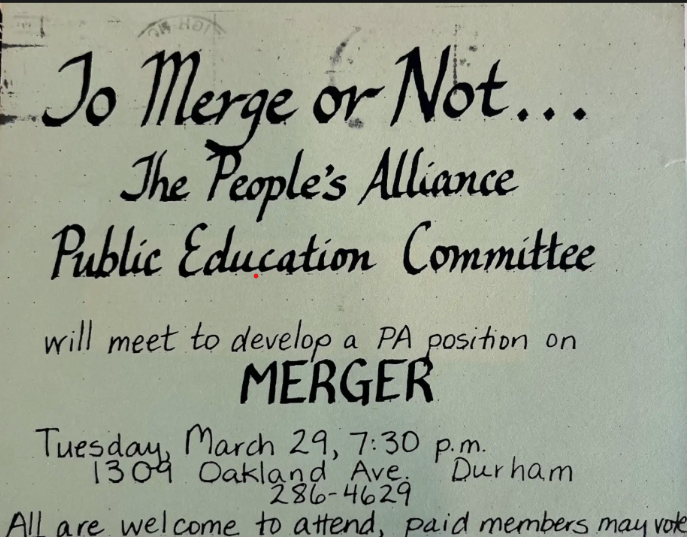
Flyer for PA's "To Merge or Not" public forum, 1988
Freemark and Hopkins’ tenures on the respective task forces made apparent the extent of the disparities, and the former would later be a primary author of the merger position paper of the Alliance. The efforts of SWAB culminated in the presentation of a report to the City Board of Education on January 24, 1989. The report listed the paramount concerns that had to be resolved before a merger could go ahead: "polling of the community attitude; annexation and the issue of coterminous school districts lines; and the merger as it would affect the education program of Durham City Schools.” SWAB concluded that the most likely remedy to the city’s staggering statistics of absenteeism, non-promotion and dropout rates was consolidation. The larger, more comprehensive, Merger Issues Task Force formed by the Board of County Commissioner in June 1988, had forty-one members who represented the Durham community. Throughout the duration of his tenure on the task force, Freemark hosted several meetings concerning the merger, both to make accessible the progress of the task force and to consider the “visions, concerns, and nightmares” of the People’s Alliance’s constituency. Many parents feared the toll consolidation would take on their children, a process almost guaranteed to be lengthy and fraught. Others felt that merger was paramount to the comparatively frivolous concern of redistricting and that the hemorrhaging of resources must be remedied to allow educators to at last address the difficulties of at-risk children.
The Merger Issues Task Force reached a conclusion similar to SWAB in late 1988. In agreement on the necessity of merger, the task force cited sobering statistics that quantified the extent of the disparities. The data was so disconcerting that the task force, which was meant to broadly study ways to improve the efficiency of the two systems, re-designated itself the Merger Study Task Force and planned another referendum for merger the next year. The County Commission, especially sensitive to the salient racial and economic implications of merger, shelved this referendum, as they felt it likely to be unsuccessful.
That did not halt community groups, least of all People’s Alliance, from continuing to pursue the issue of merger. In October of 1989, the preliminary draft of the People’s Alliance Position Paper was circulated internally, accepting suggestions and revisions. The completed position paper, “Unity and Opportunity: A Proposal for School Merger: The Durham’s People’s Alliance” was released on April 23, 1990, with People’s Alliance joining several other organizations, such as the Durham Voter’s Alliance, in support of the merger. Stressing the necessity of culturally and socioeconomically diverse school environments, faith in educators, and dissatisfaction with current state of the systems, the paper implores the County Commissioners to embrace the merger plan for the future of Durham students. The paper also listed several aspects the Alliance perceived to be critical for any merger plan, two of which would be become especially relevant in the next year: the establishment of goals for racial balance; and plans to ensure adequate representation of racial minorities in administrative positions in the merged system.
The People’s Alliance presented this paper at a hearing of the County Board of Education in May. The board expressed resistance to the plan. In response to the board’s recalcitrance, Freemark stated, “Some members of the county school administration feel the need to protect themselves against the specter of merger for reasons unknown to me.” Opponents of the merger, including many on the County School Board, had argued that the consolidation of the systems would be to the detriment of students of both systems, and that, if the people did not will it via referendum, a merger should not go forward. Nevertheless, the People’s Alliance continued to make their position known, advocating for salary increases for educators and reform of the school’s budgets at county budget hearings.
The Commissioners, aware of the opposition that would again tank a referendum vote, instead chose to rely on the authority that the state legislature had recently vested in them. In 1991, as part of its sustained push for school district consolidation throughout the state, the legislature had codified the right of County Boards of Commissioners to force consolidations without referendum. Chairman of the County Commissioners, William V. Bell, regarded the merger as essential to future of the city of Durham. Bell, with other merger proponents on the board, passed the merger resolution unanimously on June 17, 1991. The merger was set to occur on July 1, 1992. It represented a hard-fought victory for many proponents, including the People’s Alliance. In July of 1991, the County Board of Commissioners hosted a series of public forums to contribute to a Vision Statement to outline the educational objectives of merger and to serve as an addendum to the plan for merger. The Merger Vision Task Force was later created to pursue the ideas resulting from the forums, and on August 17, 1991, the task force presented their report to the Board.
Districting in the New System
Though the merger was officially approved, a herculean task still lay ahead. The new district required the creation of a new board answerable to the consolidated constituency with new voting districts, causing a protracted discourse over proportional representation. Of the many plans introduced, the 7-district plan garnered the most support within the liberal camps of Durham. The 7-district plan “proposed dividing the county into three districts – two predominately white, and one mostly black - in the mostly black district, voters would choose three candidates and in each the two mostly white districts, voters would elect two candidates.” The plan was to ensure proportional representation for the black community, and accordingly, the Durham Committee on the Affairs of Black People (DCABP) and the Durham branch of the NAACP both backed it. The People’s Alliance initially allied itself with the DCABP but later supported the 5 district, 2 at-large plan. The Alliance likely supported the 5 district, 2-at large plan because the plan vested more voting power within individuals, allowing them to vote for two board positions (the district and at-large) rather than the one position allowed by the 7-district plan. The 7-district plan was largely unpopular among white residents who expressed fears of disenfranchisement and racially divisive factions on the board.
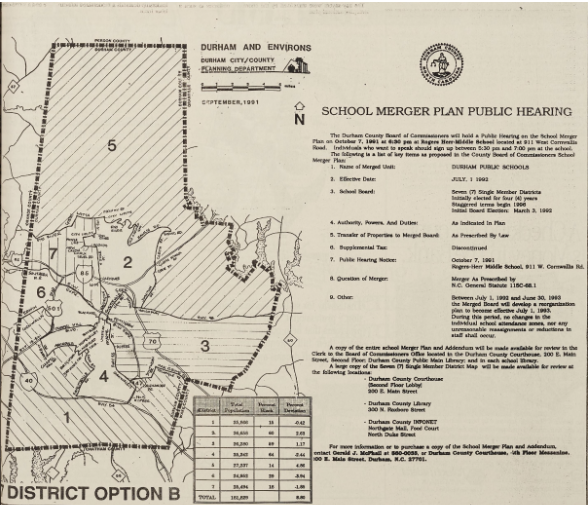
Notice for School Merger Plan Public Hearing of Board of County Commissioners, illustrating "District Option B" (the 7-distric plan), 1991
In October of 1991, the County Board of Commissioners sent the plan to the State Board of Education. However, the state board returned the plan to the Commission to force consideration of district alternatives. On November 26, 1991, the Board of Commissioners voted to resubmit the 7-district plan to the State Board of Education, and the state board rejected the plan in December, citing unignorable community opposition. In response, the Commissioners, though notably divided 3-2, voted to levy a lawsuit against the state board and argued that the state could not strip them of the lawful rights that had been vested without justifiable reason.
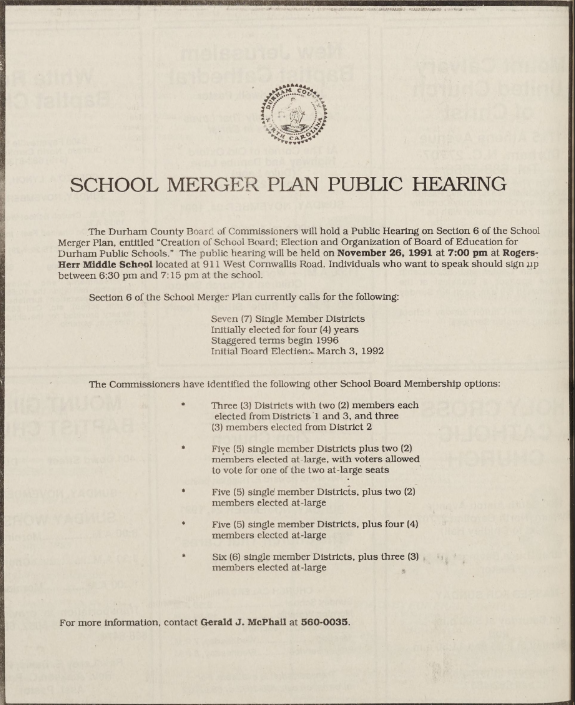
Notice for School Merger Plan Public Hearing of Board of County Commissioners, 1991
The People’s Alliance, cognizant of the necessity of the merger and eager to extinguish this debilitating lawsuit, began advocating for a "1-2-4 plan." In “Merger Alert,” an internal communique distributed on January 10, 1992, the Alliance expressed support for this new compromise option. The plan created four small districts, two regional districts from the smaller four, and an at-large seat. The Alliance argued that it would allow for not only proportional representation for black communities, but also the potential for white districts to vote for moderate candidates and reliably elect 3 of 7 members of the board. Presumably, this plan placated all major demographic groups, assuring them of their ability to seat board members. The People's Alliance members recognized that this plan represented a winning compromise. After voting unanimously for the plan at the January 22nd general membership meeting, the People’s Alliance organized a campaign of phoners and mailers to contact both members of the Board of Commissioners prior to the January 29th hearing and members of the State Board at a later date.
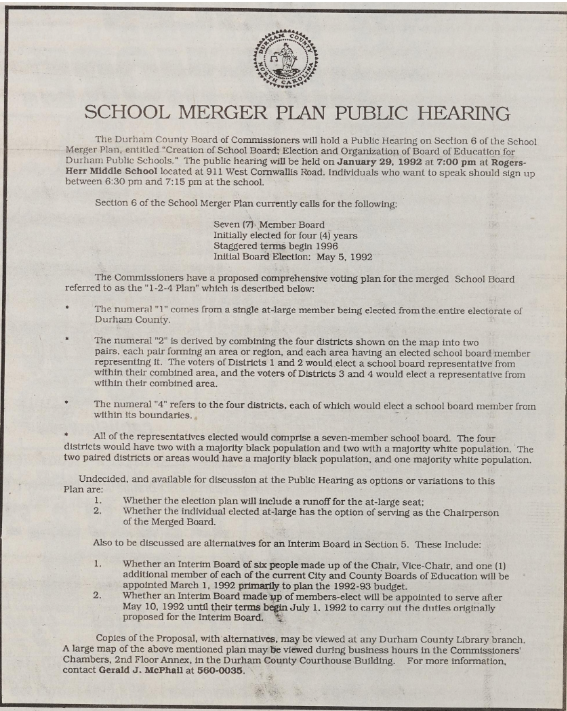
Notice for School Merger Plan Public Hearing of Board of County Commissioners, 1992
The Alliance presented the “People’s Alliance Merger Statement” at the hearing and argued for the adoption of the plan, stipulations for the at-large seat, and a clause within the plan that disallowed the Commission from taking a position on the interim board. The Alliance’s testimony, with those of other proponents, made community support of the plan clearly evident. The Board of Commissioners passed the 1-2-4 plan unanimously and sent it to the state board. Later, the Commission opted to withdraw their lawsuit. The People’s Alliance president Thomas Stern wrote directly to the state board to request adoption of the plan, citing the great majority of proponents in Durham, the unanimous vote of the County Commissioner, and the readiness of the Durham community to move past merger. The state board approved the plan on February 6, and elections for the new board occurred that May. The People’s Alliance PAC proudly endorsed candidates for the newly formed Durham Public Schools Board of Education.
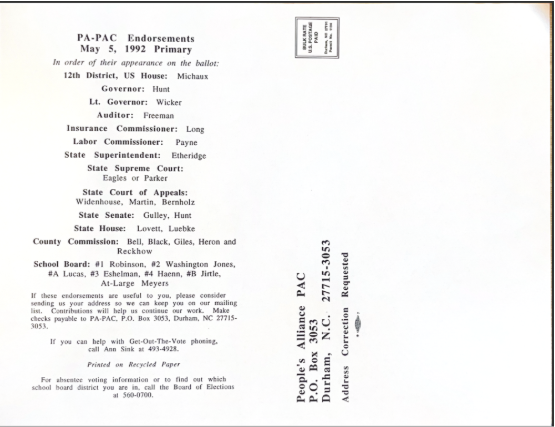
PA-PAC Endorsements for Durham County primary elections, 1992
Post-Merger
In continuance of their commitment to the merger and the future of Durham students, in August of 1992, the People's Alliance drafted “Student Attendance Plans, Recommendations of the Education Committee.” The paper, circulated to members of the school board, recommended “the adopt[ion] of “goals for racial balance against which to continuously measure attendance plans....[and] supports the concept of school choice, within the bounds of racial balance goals.” The paper marked the Alliance’s early position as a proponent for school choice plans later adopted by the board in a similar form. School choice plans allowed for a means of achieving racial balance passively, imposing less stress upon students and their families. Plans also allayed the fears of disenfranchisement held by many parents.
The Alliance also advised the Board in December of that year to complete a series of processes so that attendance plans could properly addressed: 1) an evaluation of the administrators that includes “substantive and ongoing” parent and teacher input; 2) the establishment of an process for assessing the effectiveness of programs in each school; 3) the establishment of a call in line to allow for confidential comments on schools; and 4) the intervention of the board in critical situations where students are underserved. The People's Alliance expounded on these points in their notable paper “The Good Durham School, Making Durham Public Schools Work for All Our Children: A Guidebook for Parents, Teachers, and Citizens Groups.” The paper, released in February 1993, was “intended to broaden the discussion about the nature of quality education...beyond the school walls and the school boardroom table.” Researched and authored by Page McCullough, Steve Unruhe, Rick Larsen and Dabney Hopkins, it imagined a Good Durham School to be one in which parents, citizen groups and school personnel have a stake in governance, student admission and placement, instruction, assessment, discipline, specialized programs, and support services.
The consolidation of the two systems after decades allowed for equitable allocation of resources to all Durham Public School students, regardless of their residence. The concerted, decades long effort of many Durham agents, including citizen groups, politicians, school personnel, and parents accomplished merger. Their effort remedied the racial and socio-economic segregation of the systems, improving student outcomes in Durham. As a nexus of educational advocacy in Durham, the People’s Alliance played a great role in the merger. The Alliance urged proportional representation of the merged board, school choice with consideration given to racial balance, and most profoundly, community input in schools. The legacy of their work, especially the Good Durham School, is apparent within the system today. Nevertheless, it is important to remain cognizant of the issues the system still grapples with. Budgeting shortfalls, a lack of transparency and understaffing make operations of the system difficult, harming personnel, students and their families. The Education Committee of the Alliance continues to address the issues of the system and serve as a voice for concerned parents and educators, acting in service of more equitable Durham for all.
Showing 1 reaction
Sign in with