
As Durham grew and changed during the 1980s and onward, the cost of living became a concern that spanned all classes and communities in the city. Whether addressing electric rate hikes or affordable housing, People’s Alliance positioned itself at the forefront of these issues, fighting for lower- and middle-class families.
The Durham People’s Alliance has prided itself on advocating for the working class since its beginning. A major part of that advocacy surrounds the cost of living in Durham. During its history, the People’s Alliance has been heavily involved in campaigns that dealt with the issue of rising cost of living, including power bills (such as the Duke Power rate hikes in the 1980s), housing costs, and tax burdens on the middle class. The organization worked with numerous like-minded advocacy and social justice groups in Durham, such as the Durham Committee on the Affairs of Black People (DCABP), the Durham Affordable Housing Coalition, and the League of Women Voters, to further the cause of economic justice. The People’s Alliance's role in many of these campaigns included rallying support from congress and legislature members, spreading the message throughout the community, and generating public support for specific measures.
People’s Alliance Campaigns
Taxes
Throughout the 1980s and beyond, the People’s Alliance has worked on numerous causes surrounding economic justice for the average Durhamite, including rising taxes that disproportionately affected lower-income communities. In 1986, the city of Durham elected to increase the sales tax, which would make the city an additional $1.5 million that fiscal year, and declined to repeal a food tax that many organizations had been rallying against. According to a letter from Paul Luebke, a leader of the People’s Alliance, to other members, the Commission found an unexpected $1.6 surplus from property tax revenue, undermining the budgetary justification for the tax hikes. The People’s Alliance decided to take a stance on the matter. In his letter, Luebke told PA members that the organization needed to formulate a position to take to the board, asking the city to rescind the sales tax increase and to repeal the food tax, seeing as the county already had a budget surplus.
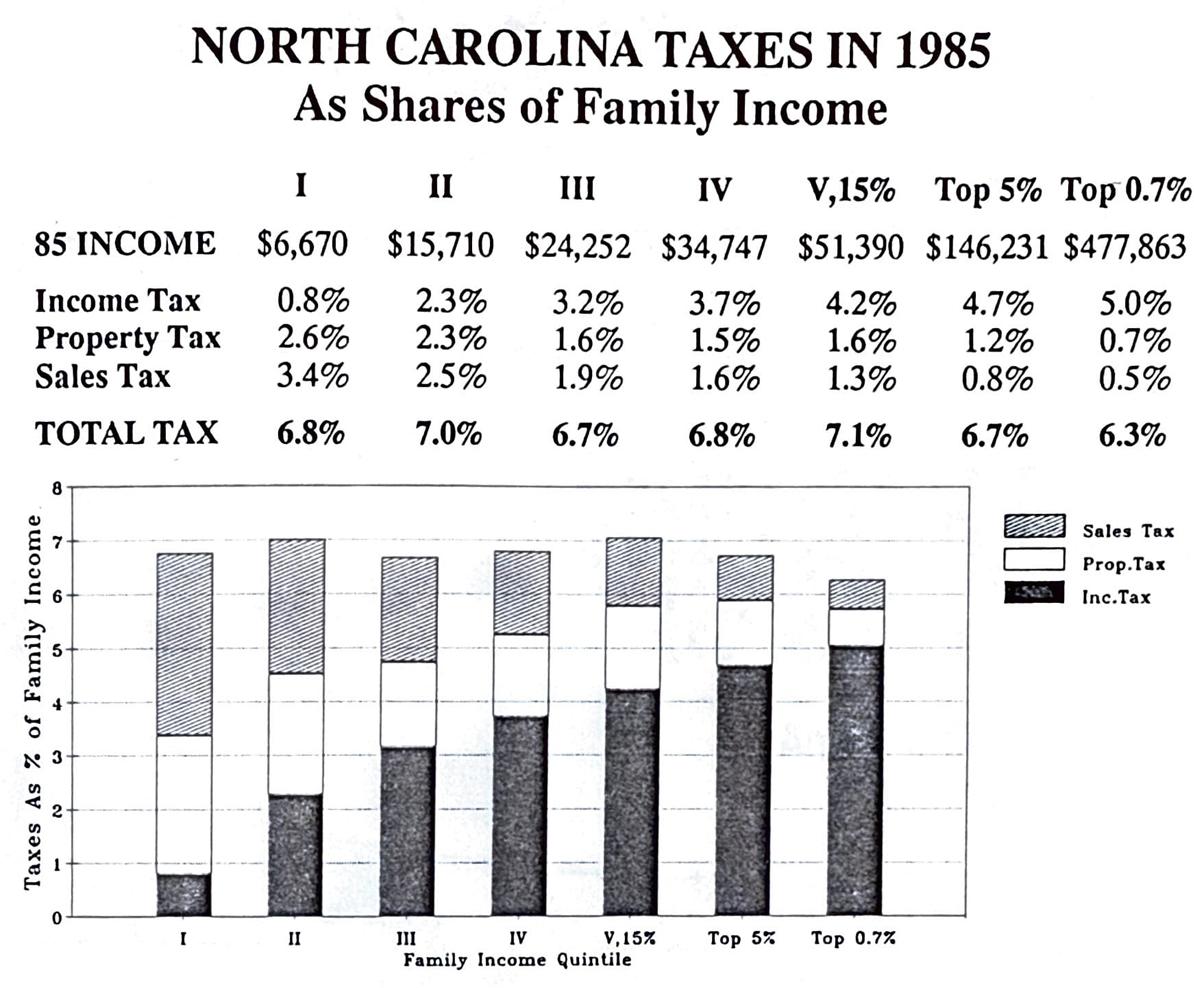
Rising local taxes were indeed a hot issue in the 1980s. Families in 1985 in North Carolina who made up the second-lowest income group out of five tracked income brackets paid the second-highest percentage of their income in total taxes out of all the income groups. Meanwhile, families in the highest income group paid the lowest percentage. This difference was primarily from sales and property taxes rather than income taxes, which is why the tax increases were especially burdensome on lower-income families.
Through public hearings and briefings to the Durham city council, the People’s Alliance was an active player in advocating for lowering these taxes. After great effort by PA and other local groups, a bill to repeal the 6% food tax was finally passed in the state legislature in 1995. Legislators, including Luebke, expressed that it was immoral to tax goods that are necessary for survival. Luebke and the People’s Alliance’s activism work in the space of tax reform reinforces the organization’s commitment to making life more affordable for everyday Durhamites.
Housing
In the 1980s, huge population growth and rising property values precipitated an affordable housing crisis in Durham. In 1988, 2,000 families were waiting for public housing, and there were 8,000 “substandard” housing units that required an average of $15k each to rehabilitate. Almost half of Durham residents made less than $20k per year. With the average home price rising to $101k, these families would not be able to afford even a home that cost half of that average to keep their housing costs at a reasonable 30% of their income. This hardship was not evenly spread across racial groups. Black Durham residents, who made on average $4,000 less per year than the average, faced disproportionate difficulty in obtaining secure housing. It was clear by the late 1980s that housing getting further out of reach for many Durham residents and even more so for black families.
The People’s Alliance’s cooperation with the Durham Committee on the Affairs of Black People (DCABP) on this issue reflects the fact that this issue, like many others, called for a cross-racial coalition. In a letter from Paul Holmbeck, the chair of the People’s Alliance Housing Committee, to other members of PA written in 1990 or 1991, Holmbeck called on PA members to take action on the affordable housing crisis. His advice exemplified the tactics the organization was using to pressure legislators and the city council to support alternatives to the free market system that was causing economic hardship for working class families. He urged them to call city council members and newspapers and mention that the shortage of low-income housing should be a top priority and that the city should assist non-profit developers, who were reaching low-income renters more than for-profit developers and who were more effective at involving the community in their planning and guaranteeing long-term affordability.
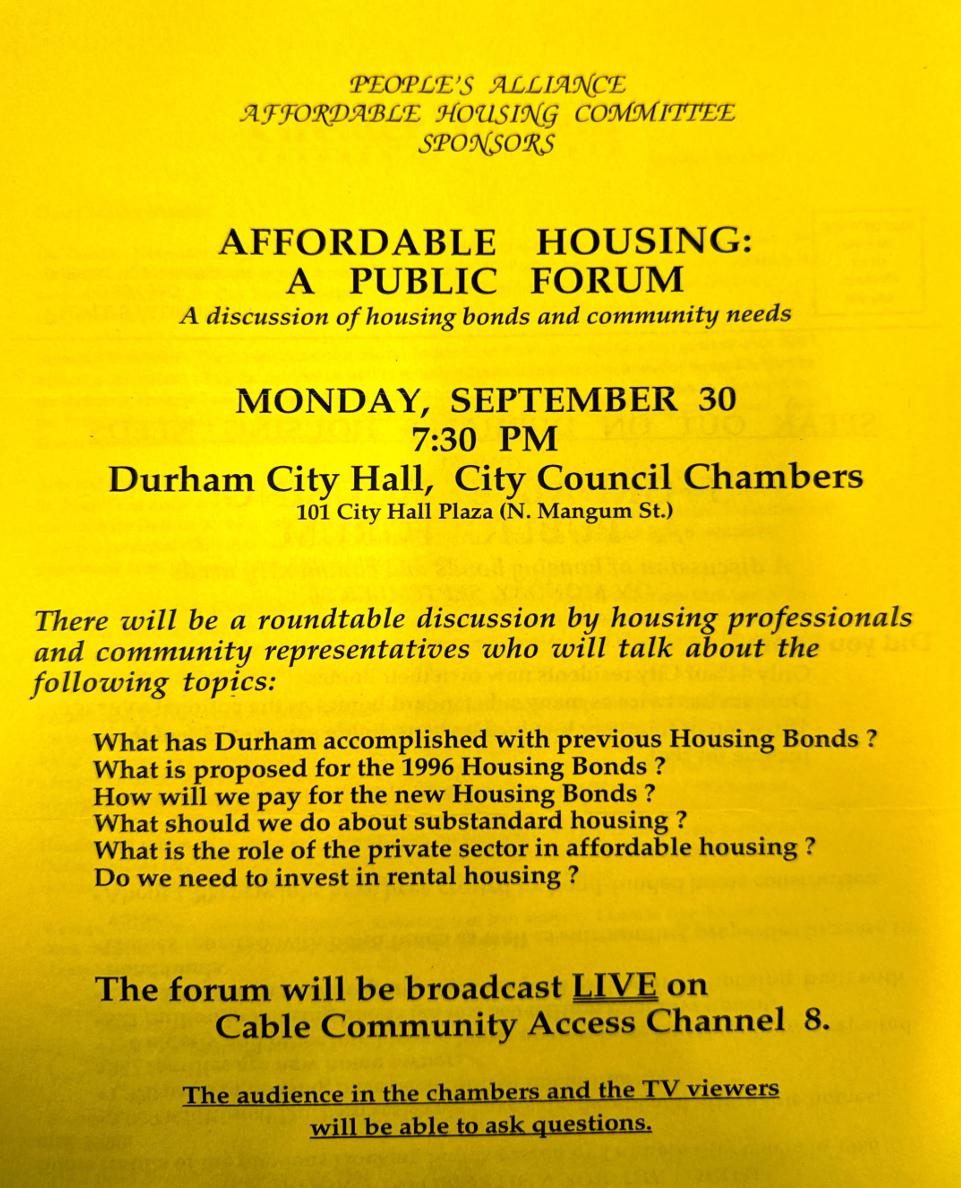
A flyer for a discussion about housing issues organized by PA
Holmbeck, working with other PA members, attended public hearings to discuss approving public bonds that would fund these non-profit developers who would build low-income housing. In a hearing on June 11, 1990, Holmbeck stressed the importance of a $15 million housing bond for the coming years to the city council. He emphasized that it would allow young families to buy homes, low-income families to afford rent, and elderly residents to improve their aging homes.
In addition to speaking to the city council, the People’s Alliance also held events to educate the public about this issue and what can be done to solve the housing crisis. The Affordable Housing Committee sponsored round-table discussions with the community to teach people the facts of the crisis, the bond packages, and what the community needed. Once the $15 million housing bond was approved by Durham voters, developers and the city housing authorities were able to revitalize neighborhoods and make housing, a survival need, a reality for many more Durham residents.
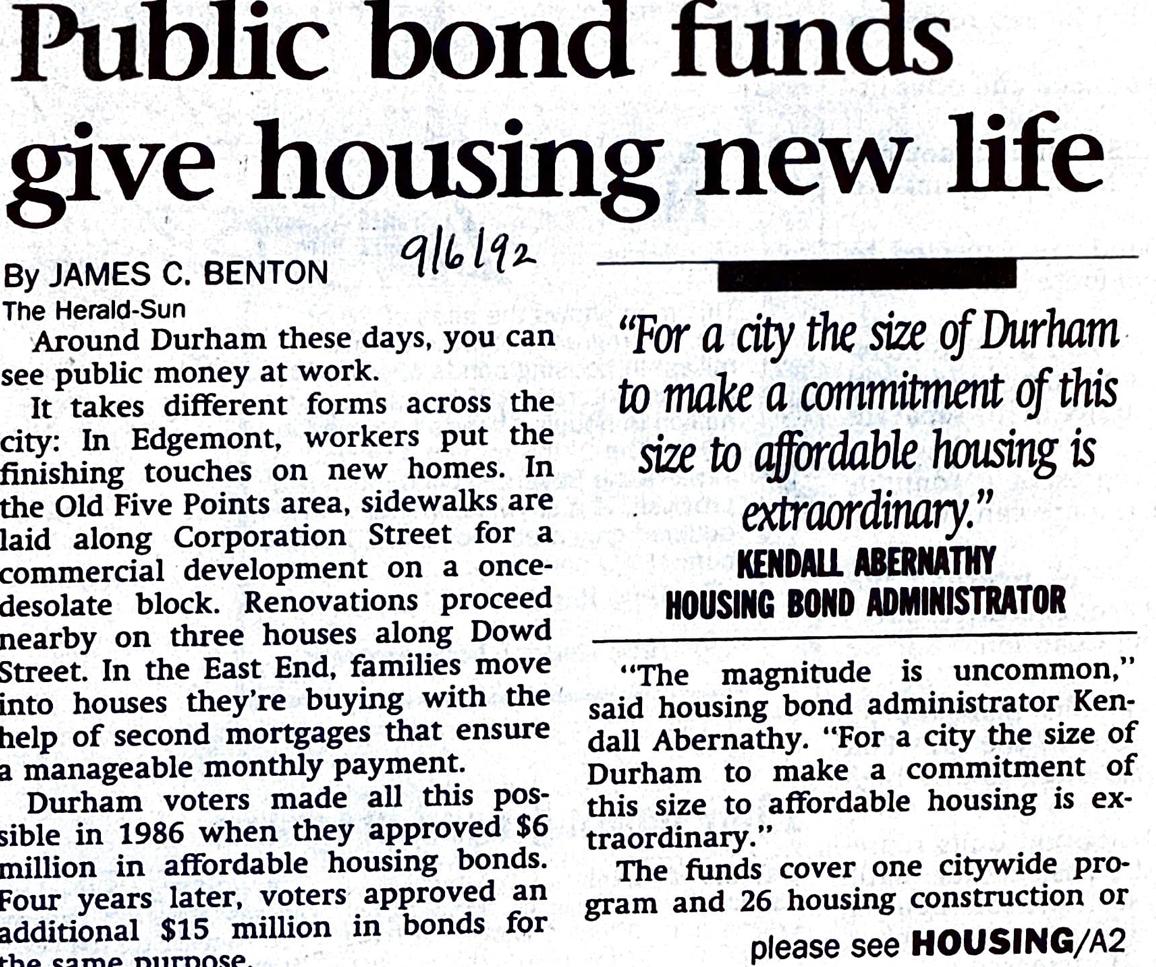
Newspaper clipping detailing the positive effects of the public housing bond
People’s Alliance and Rising Power Costs: CWIP and Duke Power Rate Hikes
With electric rates skyrocketing for Durham residents in the 1980s, the young People’s Alliance fought against the system of large companies taking advantage of everyday Durham locals’ need for electricity. This included companies pushing to add “Construction Work in Progress” to already-high power bills, and Duke Power hiking prices to line stockholders’ pockets.
The People’s Alliance was heavily involved in coordinating the Durham community’s response to these cost increases. Both issues presented great challenges to the working and middle classes in Durham, and the People’s Alliance was committed to advocating for them and preventing companies such as Duke Power from continuously raising prices and making higher profits at the expense of ratepayers.
The People’s Alliance was a major player in the community because it raised public awareness about these issues. Many flyers created by the People’s Alliance circulated during the 1980s about Duke Power raising their rates each year. It is evident from pamphlets, newspapers, and letters that the people of Durham were not happy with their already-high bills going up to fund Construction Work in Progress and more returns to Duke Power’s stockholders. Because this was a forefront issue in Durham for much of the 1980s, the People’s Alliance worked tirelessly with other organizations and with the city of Durham to make electricity affordable for the working class.
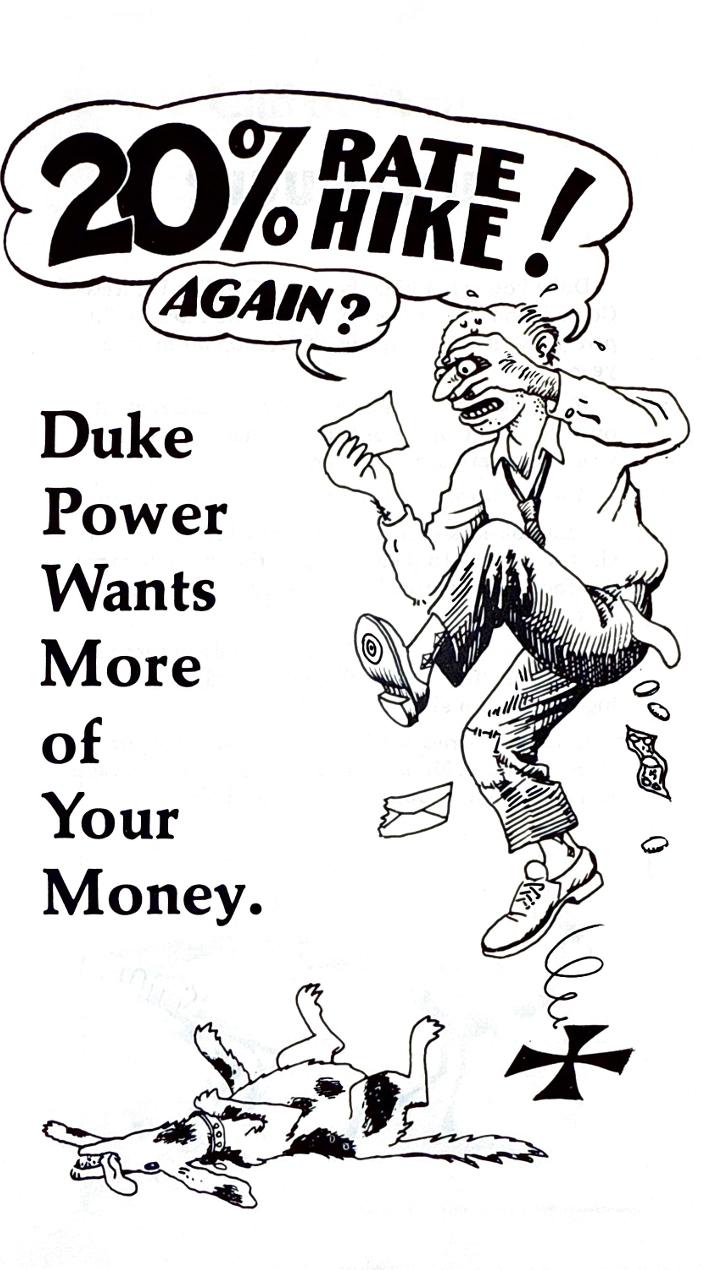
A brochure cover spreading the message about Duke Power rate hikes
In 1980, Duke Power’s electric rates increased by 19.7%, adding $211 million to their yearly revenue. $6 million of that increase was for Construction Work in Progress, and $110 million was for the McGuire nuclear plant construction costs. The McGuire plant eventually turned out an expensive failure, and the fact that Duke Power was forcing ratepayers to pay for their mistake was maddening to the community. Additionally, $50 million of the rate increase simply went to extra profits to the company’s stockholders. While Duke Power was making record profits, everyday Durham residents were struggling to pay for their electricity.
Groups including the Committee for Fair Electric Rates and the People’s Alliance accused Duke Power of overcharging and appealed to the City Council’s utilities commission not to approve further rate hikes. On July 29, 1983, the People’s Alliance organized a protest against Duke Power’s proposed 1983 rate hike, which would have ratepayers pay for a cancelled Cherokee power plant. “We wanted to bring the message to Duke Power that the public does not intend to sit back and swallow these unjust costs,” said PA spokesperson Kenny Foscue in a press release. The People’s Alliance worked to spread awareness through press releases, letters, and flyers in the Durham community that Duke Power was unfairly raising their prices and that the public could do something about it.
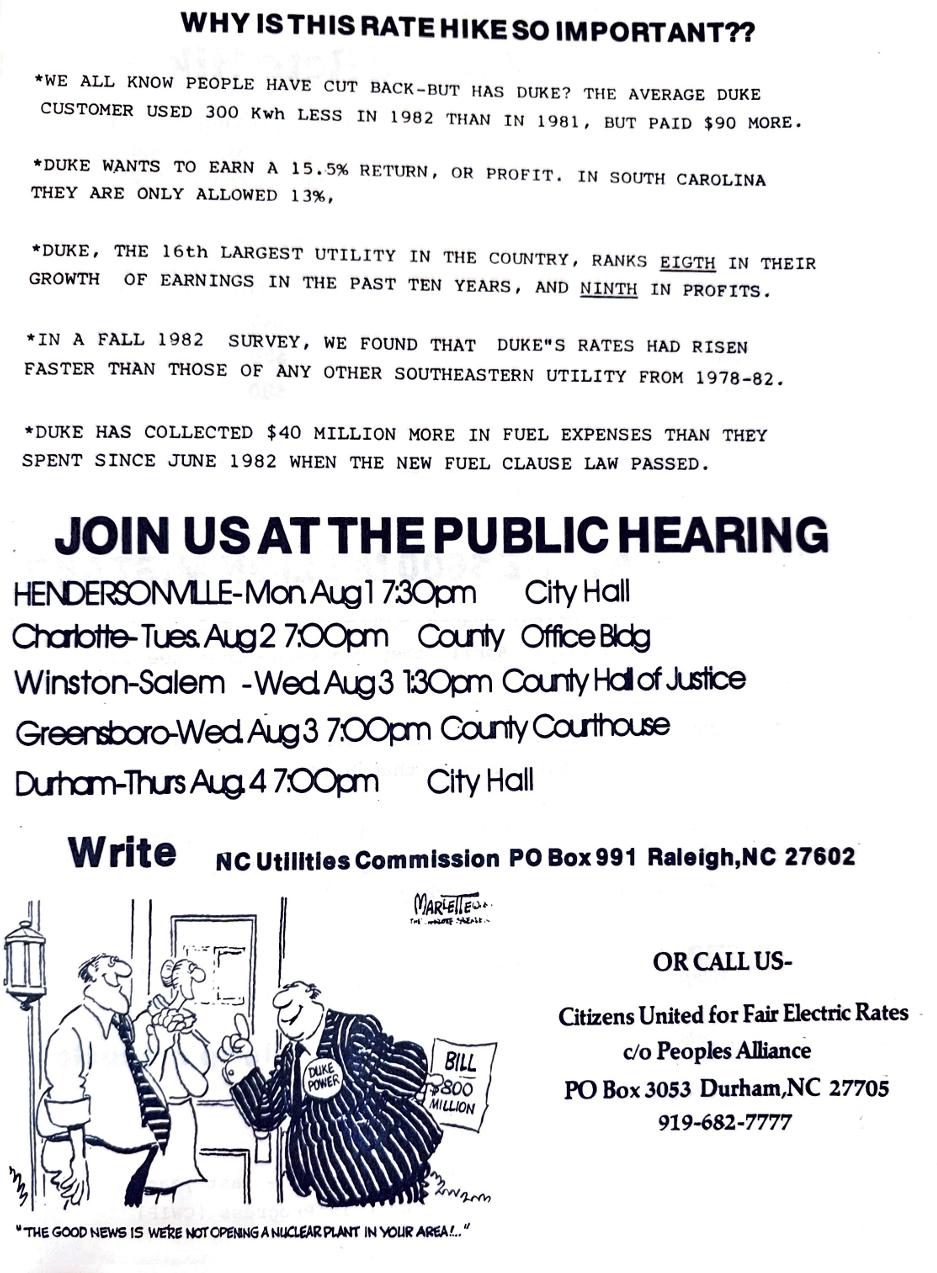
A flyer from the People's Alliance encouraging people to attend a hearing about rate hikes.
PA representatives urged people to attend public hearings for opponents of the rate hikes to voice their opinions. Elisa Wolper, who was active in the People’s Alliance at the time and started the Committee for Fair Electric Rates, told the Sun Triangle Scene Newspaper that, “even though Duke Power has just recently tacked on the cost of the Cherokee plants, the public is very aware of it.” Up to 1984, Duke Power had requested a rate increase almost every year since 1970 and had received a majority of their requested increases. But that year, when Duke Power requested yet another rate increase of 13.6%, costing the average consumer an extra $8.77 per month, the Durham city attorney’s office agreed to enter the case on the side of ratepayers after the People’s Alliance requested their intervention.
The People’s Alliance’s efforts were significant, and they effectively led to Durham residents and elected officials being vocal about their disapproval of the extensive rate hikes. The People’s Alliance helped send a clear message to Duke Power, the city of Durham, and the Durham community: that they would fight against paying large corporations to make record profits while the middle and working classes struggled with their bills.
PA also addressed the issue of Construction Work in Progress (CWIP) charges on ratepayers’ bills. Starting in the 1970s, electric companies began including the costs of building new power plants in monthly power bills paid by ratepayers. This enraged ratepayers and activist groups, as they felt it was unfair that they would be paying not only for power plants that were already built and that they were using, but also for plants that they may never use (if they moved to a different city, for example). Ratepayers were footing the bill for investment in a power plant, and the electric companies and their benefactors would reap the benefits with little financial risk.
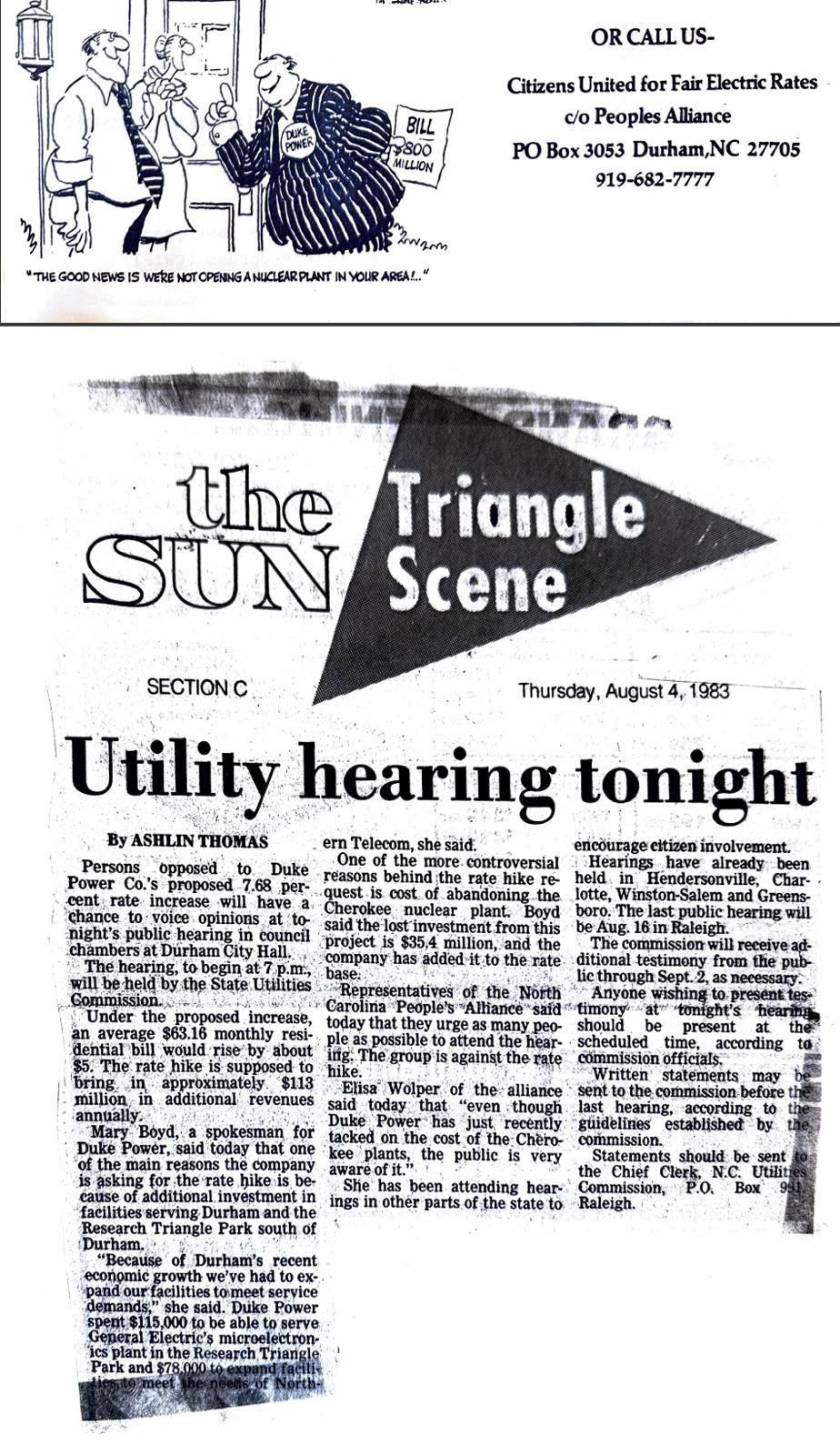
Newspaper clipping that mentions PA members' contributions to a utility public hearing
Community groups tried to campaign against CWIP before became official in mid-1979, and they continued to agitate against it even after it went into effect. Among the groups working on this issue, the People’s Alliance’s role was to use its resources, knowledge, and connections to reach out to the public. PA worked to get out the message that CWIP was unfair and protected corporate interests over the people’s good. Additionally, because PA had a broad constituency that crossed many progressive issues, it could keep the CWIP campaign tied to the broader topic of economic justice and attract even those better-off consumers who felt the financial impact less, but sympathized with the broader social struggle.
In early 1979, the People’s Alliance established a committee that dealt with utility reform issues such as CWIP. The committee sent letters, made calls, and spoke at hearings, to pressure elected officials to repeal CWIP. One example of this work is a letter sent from the People’s Alliance of Greensboro to the NC General Assembly in 1980 that urges the Assembly to repeal CWIP and support the efforts of the Committee for Fair Electric Rates as CWIP was an unfair burden and an investment risk taken on by consumers who may not see the benefits of the future plants. While CWIP was never officially repealed, it has been subject to tighter oversight and regulation, and Duke Power scaled back its reliance on CWIP charges in the late 1980s and 1990s. PA’s role in this campaign reflects PA’s dedication to lowering rates of necessities for the people of Durham.
People's Alliance and Economic Justice
The People’s Alliance has shown great dedication to advocating for Durham’s middle and working classes through its work on cost-of-living issues. PA used tactics such as protests, letters, and speeches at public hearings in front of legislators to further their causes of lowering electric rates and taxes on the working class. The organization also used flyers, events, and the news to rally support from members of the Durham community. PA’s work reflects its commitment to giving a voice to the working class and bringing people from the community together, as is apparent from its collaboration with many other Durham organizations. While the political climate and hot-button issues may have changed since the 1980s, the People’s Alliance’s long-held values remain strong.
Showing 4 reactions
Sign in with